Cat Night Vision: What Makes It So Effective?
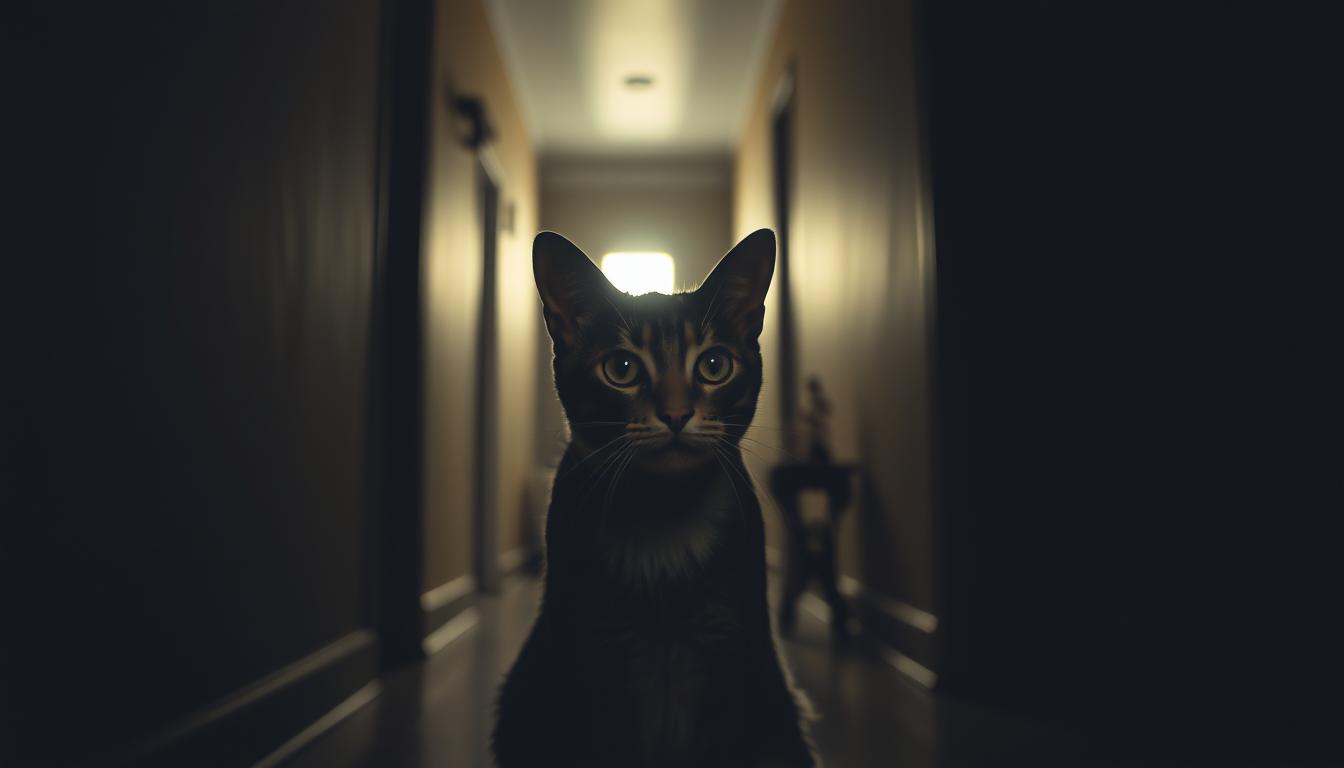
Cats see far better than people in dim light, but they cannot see when no light is available. Their low-light vision helps them move and hunt when you might struggle to make out a room.
That ability matters when your pet heads down a dark hallway or watches movement outside at night. Cat night vision is impressive, but it is not supernatural. Seeing in dim conditions is different from seeing with no light at all.
Your cat’s eyes and other senses help it use the light that is there. This article explains what cats can see, what remains blurry, and when a change in sight needs care.
Table of Contents
Your cat’s apparent confidence after dark comes from using scarce light efficiently, not from seeing in total darkness.
Does Cat Night Vision Work in Complete Darkness?
A cat cannot see in complete darkness, but it can make use of much less light than you can. Even a small amount of light can help a cat form a visual image. Cats night vision works best when some light reaches the eyes.
In a room with absolutely no light, a cat’s eyes cannot provide a visual image.
Cats need some light to form a visual image
Night vision does not mean seeing without light. A cat may move through a room that looks nearly black to you because its eyes can use dim light more effectively.
That advantage has limits. A covered window, closed door, and turned-off lamps can leave a room too dark for sight. Your cat may still move, but it cannot rely on a visual picture there.
A cat’s sensitivity to light is thought to be about six times greater than a human’s. The difference helps explain why cats see in conditions where your eyes have trouble adjusting.
Dim rooms can still hold useful cues, such as light from a window or a nearby screen. These small sources do not make the room bright, yet they can support a cat’s sight.
Dawn and dusk suit a cat’s activity pattern
Cats are crepuscular, which means they are generally most active around dawn and dusk. These parts of the day offer more light than night, but less glare than midday.
This pattern helps explain why your cat may become lively before sunrise or near sunset. Cats are not strictly nocturnal, even when their nighttime behavior makes it seem that way.
Activity can vary from one cat to another. A pet’s routine also reflects its home, age, and daily habits, so a burst of play at night does not prove it sees in darkness.
In a room with absolutely no light, a cat’s eyes cannot provide a visual image.
Which Eye Features Let Cats See in Low Light?
A cat’s low-light advantage comes from several parts of the eye working together to collect and use available light. Each part has a role, from letting light in to helping detect it.
The retina is the light-detecting tissue at the back of the eye. It contains many rods, the light-sensitive retinal cells that support sight in dim conditions, and cones, the color-sensitive retinal cells that support color vision.
The tapetum lucidum is a reflective layer behind the retina that sends available light back through the light-sensitive cells for another chance to be detected. A curved cornea and large lens also help gather light and focus it toward the retina.
| Eye feature | What it does with light | What you may notice |
|---|---|---|
| Rods in the retina | Help detect light in dim conditions | Better sight in low light |
| Pupils | Widen to let in more light | Large pupils in a dim room |
| Tapetum lucidum | Sends available light back through the retina | Eyeshine in a flash photo |
A cat’s pupils can change in area by about 135-300-fold. Human pupils change by about 15-fold, so a cat’s pupils adjust across a much wider range of light.
The reflective layer can return more than 50% of available light through the retina. This gives the light-sensitive cells another chance to detect it.
Cat vision color still differs from human sight. Cones enable color vision, but cats’ color perception is more limited than humans’. They can see colors, though not the same range of shades.
Eyeshine in flash photos or headlights is reflected light, not light made by the cat. The eye-shine you see in a photo or headlights is the tapetum reflecting incoming light back out.
How Does Cat Vision Compare With Human and Dog Vision?
Among cats, dogs, and humans, cats see best in the dimmest light, while humans see finer detail. The low-light winner is not the sharpest viewer in every setting.
Cats need less light than dogs or humans, while dogs also see in dimmer light than humans need. The table compares their relative sight and shows where each species has an edge.
| Measure | Cats | Humans | Dogs |
|---|---|---|---|
| Relative light needed | About one-sixth of human light | Baseline | About one-fifth of human light |
| Visual acuity | 20/100-20/200 | 20/20 | About 20/75 |
| Field of view | About 200 degrees | About 180 degrees | Wider than humans’ |
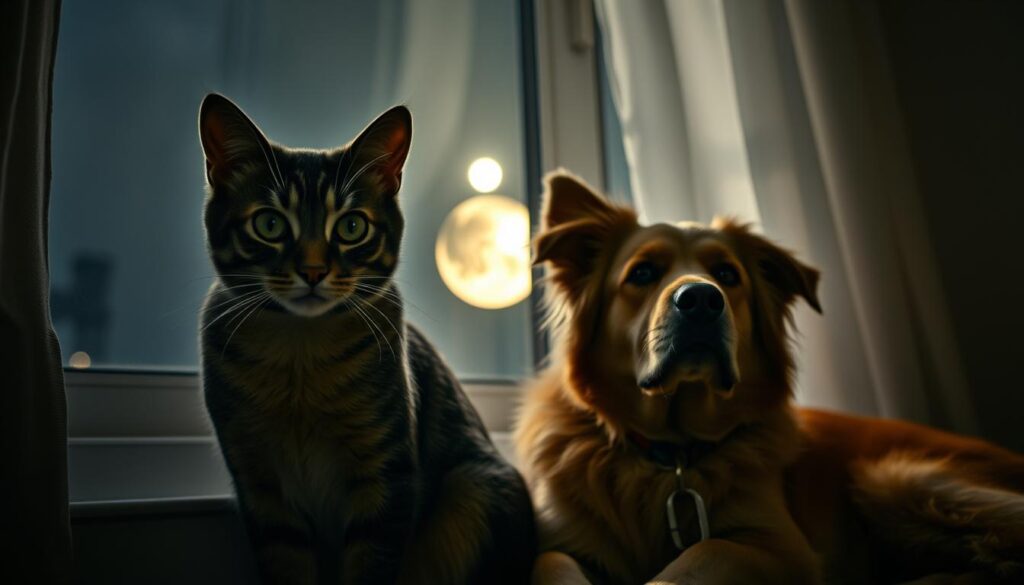
For cat vision vs human vision at night, light sensitivity matters more than sharpness. Cats see in dimmer conditions, while humans can pick out finer details and a wider range of color.
For cat night vision vs. dog and cat vision vs. dog vision, cats are the low-light winner. Dogs also need less light than humans, and their field of view is wider than a human’s.
Cat visual acuity ranges from 20/100 to 20/200, compared with 20/20 for humans and about 20/75 for dogs. That means a cat may miss small details that you can see clearly.
Motion can stand out even when a target’s fine detail looks blurry. A moving mouse may catch a cat’s eye sooner than a still object nearby.
The best low-light sight does not mean the sharpest overall picture.
What Colors and Details Can Cats See?
Cats see a more muted range of colors than you do, and distant details look less crisp. Color vision is limited, but cats still notice changes in their surroundings.
Cats have two types of cone cells, while humans have three and about ten times more cones. That difference gives people a wider range of color variations.
Which colors stand out to cats?
Cats see mostly muted blues and greens. Reds and pinks are harder for them to distinguish, so a bright red toy may look less striking to a cat than to you.
Cat vision and color are not the same as a black-and-white picture. Cats see some shades, but their color range is less rich than the range humans see.
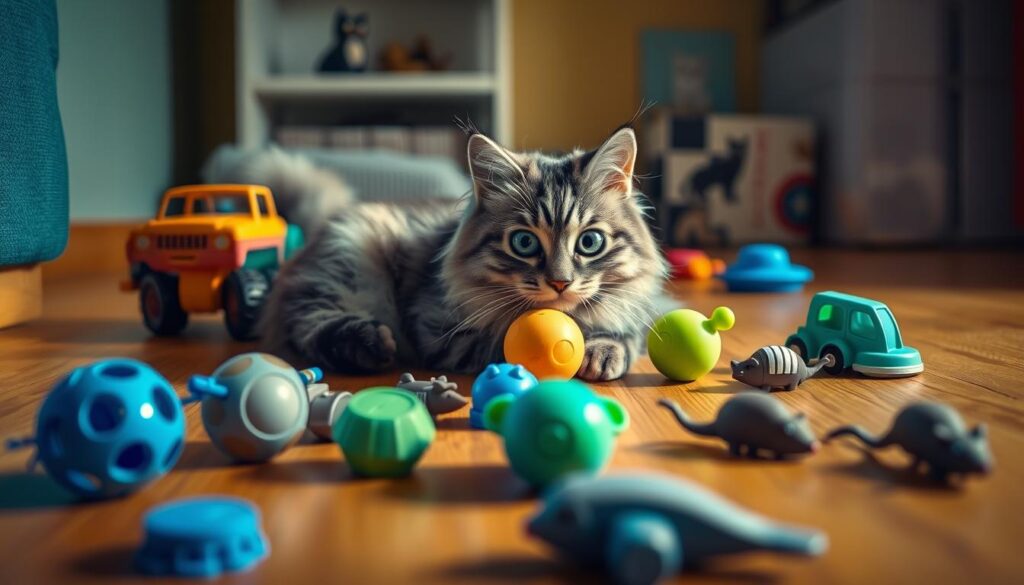
A cat-vision filter can offer a rough idea of this difference. It is only an approximation, not a literal overlay that exactly recreates what a cat sees.
Why distant details look less distinct
Cats have less visual acuity than humans, so fine details fade sooner with distance. A person may be up to five times farther away than a cat and see an object in the same detail.
That difference can shape how cats see humans. Your cat may notice your outline and movement before it makes out small facial details across a room.
Familiar cues also matter. Your voice, scent, and usual way of moving can help your cat recognize you when your face looks indistinct.
A cat may react to your movement even when it cannot make out your expression. A familiar person’s movement can be easier for a cat to notice than small facial details from across a room.
How Do Cats Navigate When It Is Dark?
In a familiar dim room, a cat combines sight with information from its whiskers, hearing, and memory. These cues add context when visibility is limited.
Other senses can help a cat move, but they do not let it see in total darkness. A cat’s side sensory hairs, also called vibrissae, detect nearby objects and changes in airflow.
- Whiskers or vibrissae can sense nearby objects and shifts in airflow, helping a cat judge tight spaces.
- Hearing helps locate sounds, such as a toy rolling across the floor or a familiar person calling.
- Memory of a familiar room layout helps a cat avoid obstacles it already knows.
The outer ear flaps are called pinnae. Their position can help direct sound toward the ears as a cat listens for activity nearby.
These cues work together rather than replacing sight. A cat may hear a sound, turn toward it, then use the available light to inspect the area.
Movement can also draw attention in low light. A small moving object may be easier to notice than a stationary one because its motion stands out.
That can help a cat track prey or a toy without seeing every detail. It does not mean every dark-room movement has a clear visual shape.
A familiar layout is useful, but new objects can still get in the way. Keep familiar pathways clear if your cat needs to move around in low light.
What Signs Suggest a Cat Has a Vision Problem?
A sudden change in how your cat navigates familiar spaces deserves more attention than ordinary nighttime caution. New behavior matters, especially when it appears with signs of eye discomfort.
Contact a veterinarian about sudden changes in dim-light navigation or any sign that your cat’s eye hurts. Cats may adjust their behavior when sight changes, which can make a problem less clear at first.
- Bumping into furniture or walls
- Hesitating in familiar surroundings
- Cloudy or discolored eyes
- Persistent squinting or blinking
- Pupils that do not respond to changes in light
Eye changes can have different causes, and a home check cannot tell you which one is present. A veterinarian can assess the eyes and look for conditions such as cataracts or glaucoma.
Arrange a veterinary examination promptly if the change is sudden or the eye looks painful.
The Cornell Feline Health Center’s guide to feline vision problems describes possible causes and signs of impaired sight.
For general cat-care information, Biggy Paws explains its educational approach to pet health and recommends veterinary advice for health concerns.
A change that seems small during the day may become clearer when your cat enters a dim room. Arrange a veterinary examination promptly if the change is sudden or the eye looks painful.
Conclusion
Your cat’s nighttime confidence comes from specialized eyes and other sharp senses, not from seeing in pitch black. Cats use available light well, yet they still need some light to make a visual image.
Pay attention to how your pet moves through familiar spaces. A new hesitation, bump, or eye change is worth noting, even if your cat still seems confident.
If your cat’s vision seems different, note what changed and ask your veterinarian for an eye check.