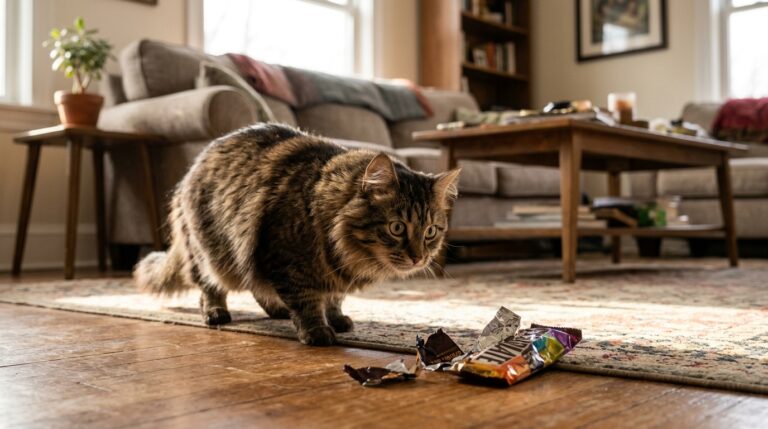
Do Cats Have Night Vision?
Your cat can move confidently through a dim room, but it cannot see when the room has no light at all. At night, that difference matters when your pet explores a hallway, climbs furniture, or looks for a familiar spot. Night vision helps it use weak light, but it does not work like a built-in flashlight.
The tapetum lucidum is a reflective layer behind the retina that bounces incoming light back through the retina. Knowing what your pet can detect helps you tell normal night activity from a change worth noting. A small amount of ambient light, not total darkness, is what makes feline night vision possible.
Key Takeaways
- Dim light gives your pet enough to make out parts of a room.
- Complete darkness leaves it without visual information.
- Rods help detect light and movement.
- Eyeshine comes from reflected light, not glowing eyes.
- Familiar routes can help a pet move around safely.
- New changes in navigation deserve attention.
How Well Do Cats Have Night Vision in Low Light?
A cat can make out more in a dim room than you can, but it still needs some light to form an image. Low-light conditions give it an advantage, while a room with no light leaves it without a usable view. Do cats have night vision? Yes, they see well at night when some light is available.
That ability can help your pet find a path at twilight or cross a room lit by a distant window. It does not mean every shadow becomes clear, or that a dark room feels bright to your cat. The amount of light still shapes what it can make out.
How Little Light Can Cats See In?
Cats need about one-sixth as much light as humans to see. Twilight and a dim room can provide enough light for your cat to notice nearby objects and movement. Those settings can support useful night vision, even when details remain hard to see.
Good eyesight at night is most useful when some ambient light reaches the room. A faint glow from outside may help your pet find familiar furniture or follow a known path. Its vision may not reveal every small object on the floor.
Why Pitch-Black Rooms Stop Their Vision
Vision depends on light reaching the eyes. In a pitch-black room, there is no light to form an image, so your cat cannot see its surroundings by sight.
No cat can see in a room with zero light, no matter how well it handles dim conditions.
Other senses may still help your pet respond to sounds or touch nearby surfaces. Those senses do not turn darkness into a visible scene, though. If you cannot see any light source in the room, do not expect your cat to navigate by sight alone.
What Lets Cats See in Low Light?
A cat’s low-light advantage comes from several parts of its eye working together to capture available light. Its rods, reflective tissue, and pupils each play a role. Together, these features help its eyes make use of weak light.
Cats gather and reuse more available light than humans do. This helps explain how they see in a dim room, but it does not give them sight when no light enters their eyes.
Rod Cells Pick Up Light and Movement
Rods are light-sensitive retinal cells that help cats see in dim settings and notice movement. Cats have more rod cells than humans, which helps them pick up small changes in a scene.
Cones are another kind of light-sensitive cell. They support color vision, while rods are better suited to finding light and motion. The balance of these cells shapes what your pet notices in a darkened room.
The Tapetum Lucidum Reflects Light
The tapetum lucidum is a reflective layer behind the retina that bounces incoming light back through the retina. This second pass gives the retina another chance to receive the light that entered the eye.
A cat’s tapetum can allow the retina to receive more than 50% of available light. A camera flash can bounce off this reflective layer and return toward the camera. That reflected light creates eyeshine, the visible glow in the eyes.
Flash photographs may show yellow, green, or another bright-looking color in the eyes. The glow comes from light reflecting out of the eye, not from a light source inside it.
Pupils Open Wide to Let Light In
A cat’s large cornea and lens help gather light before it reaches the retina. In low light, its pupils expand to let more light enter. In brighter conditions, the pupils narrow.
The area of a cat’s pupils can change by 135-300-fold. Human pupils change in area by about 15-fold. That wider range lets a cat adjust to a broad range of lighting, from a dim room to brighter surroundings.
The pupils also change with more than light, so their size alone does not tell you everything about your pet’s mood or health. The glowing look in a flash photograph is reflected light, not light produced by the cat’s eyes.
How Does Cat Vision Compare With Human Vision?
In dim light, cats have the advantage, but you can see more fine detail at a distance. Cats see better than humans in low light, especially at dawn and dusk. The trade-off is that distant objects may look less sharp to them.
Cats detect motion more accurately, while humans see distant details more clearly. Their broader view can also help them notice activity around them. The table compares key parts of cat vision and human vision.
Do Cats See Better in the Dark or Light?
Cats have more rod cells than humans, and rods help detect motion, including small movements at a distance. Their more accurate motion detection can help them spot a moving object in dim conditions. Dawn and dusk offer the mix of available light and activity where this skill stands out.
A cat’s visual field is about 200 degrees, compared with about 180 degrees for humans. That wider field does not mean every object looks sharp. Cats may not see an object clearly until it is about 20 feet away.
| Feature | Cats | Humans |
|---|---|---|
| Low-light comparison | See in about one-sixth the light | Need about six times more light |
| Visual field | About 200 degrees | About 180 degrees |
| Distance clarity | May not see an object sharply until about 20 feet | An object clear at 100 feet to a human may look blurry to a cat |
| Motion detection | More accurate, including small movements at a distance | Less accurate than cats |
An object you can see clearly from 100 feet may look blurry to your cat. A dog also sees well in low light, though cats have an advantage in dim settings.
How Do Cats See Humans?
People can look less sharp from a distance, but a familiar person is more than a face to your pet. Cats can use a person’s visual appearance and movement when recognizing someone they know.
Your cat’s view of a familiar person depends on more than a sharply defined face.

What Colors Can Cats See?
Cats do see colors, but they do not see as many variations as you do. Their world includes mostly shades of blue and green, and those colors look less vivid than they do to humans. Color vision is present, just more limited.
Cats see color, rather than a black-and-white world. Their view has fewer clear differences between some shades. That can affect how they notice a toy or object by color alone.
Which Colors Stand Out to Cats?
Shades of blue and green stand out most in a cat’s color range. Red and pink can look muted or difficult to tell apart. A bright red object may not catch your pet’s eye because of its hue alone.
Color is only one clue your cat can use to notice an object. Its shape, position, and movement can also matter. A toy that moves may draw attention even when its color is hard to distinguish.
Why Human Color Vision Is Richer
Cone cells support color perception. Humans have 10 times more cones than cats, which lets people perceive more color variations. That difference helps explain why a room’s colors may look richer to you than they do to your pet.
Human color vision can separate more shades across the visible world. A cat’s smaller range does not mean it sees only gray. It sees a world with fewer color details and less vivid shades.
A cat’s color range is more muted than a human’s, not a black-and-white view.

How Do Cats Navigate When It’s Dark?
In a dim room, your cat can combine sight with other senses and knowledge of the space. Whiskers, hearing, and memory help it move around when the light is weak. Available vision is only one part of how cats see dark rooms.
Cats navigate with a mix of sight, touch, hearing, and familiar layouts. Their whiskers can detect changes in air currents near an obstacle. Hearing can help them locate a sound elsewhere in the room.
A familiar layout gives your cat another useful cue. It may remember where furniture sits and where a hallway leads. These aids can help your feline friend move through a known space, but they do not replace vision.
| Navigation aid | What it contributes | Example |
|---|---|---|
| Dim-light vision | Uses available light to make out surroundings | Moving along a familiar path |
| Whiskers | Detect changes in air currents | Sensing a nearby obstacle |
| Hearing | Helps locate sounds | Orienting toward a sound in the room |
| Memory | Retains a familiar layout | Moving around familiar furniture |
Small changes to the home can make a familiar route less easy to follow. Keep the path to food and the litter box clear, especially for an older pet. A small nightlight near a hallway or litter box can help an older or vision-impaired cat.
Try these simple ways to keep everyday routes familiar:
- Keep routes to food and litter clear.
- Use a small nightlight near a hallway or litter box for an older or vision-impaired cat.
- Avoid unexpectedly rearranging familiar furniture.
For a cat with reduced vision, keep the route to everyday essentials easy to follow.
When Should You Worry About Your Cat’s Eyesight?
A sudden change in how your cat navigates familiar spaces deserves attention. New changes can be a reason to seek an assessment, but an observation alone does not show what caused it. A veterinarian can assess your cat’s eye health and vision.
A new or persistent change in your cat’s eyes or navigation is worth a veterinary exam.
- Squinting or rubbing the eyes
- Cloudiness or discoloration
- Hesitation in familiar surroundings
- Bumping into objects
- Excessive tearing or pupils that do not respond to changes in light
Healthy adult cats generally need at least one wellness exam each year. Older cats or cats with health conditions may need checkups about every six months, as their veterinarian advises. Arrange a veterinary exam if you notice a new or persistent change in your cat’s eyes or navigation.
Conclusion
Your cat’s eyesight is specialized for dim conditions, not complete darkness. Cats are better adapted to weak light than humans, but they still need some light to see. That limit matters when you think about how your feline friend moves through the home at night.
Notice which lighting conditions your cat handles comfortably during normal routines. This gives you a useful point of comparison if its movement changes. Keep a simple note of any change in how your cat manages familiar spaces and share it at a wellness visit.