Gray and White Cats: Breeds, Traits, and Care
A gray-and-white coat can belong to a pedigreed cat or a mixed-breed companion, and the markings alone do not tell you which one. You may be choosing a first pet, adding a friend for another animal, or simply drawn to this striking look.
Color and pattern do not prove pedigree or predict personality. The right choice calls for more than a pretty coat: you need to consider the cat’s habits, health, and care needs, along with the time you can give.
You will learn how gray and white patterns look, which breeds may have them, and what daily care can involve. You will also find ways to judge an individual cat’s temperament and prepare for adoption. That can help you focus on fit, rather than choosing by color alone.
The best match is the individual cat whose needs and personality fit your home.
Key Takeaways
- Gray-and-white fur appears in pedigreed and mixed-breed cats.
- Coat patterns describe appearance, not a cat’s breed.
- Personality depends on the individual cat and its experiences.
- Coat length and texture help shape grooming needs.
- Meeting a cat can show whether its needs suit your home.
Table of Contents
What Is a Gray and White Cat?
The usual short answer is bicolor, while piebald describes a coat with pigmented areas and white spotting. A gray white cat may have broad patches, small white areas, or markings that look like a formal suit.
Bicolor means a coat pattern with two colors, often a pigmented color and white. “Piebald” is another term for fur with pigmented areas and unpigmented, or white, areas. These terms describe the coat, not a breed.
Use the cat’s markings to describe its appearance, not to guess its breed.
Tuxedo describes a high-contrast pattern traditionally linked with black and white fur. People also use the term for gray and white cats with a similar suit-like look. A white cat with gray markings may fit that description, too.
White paws may be called spats, especially when they stand out against darker legs. Some cats have just a few white toes, while others wear white “socks” that reach higher up the leg.
Coat terms can help you describe what you see at a shelter or to a veterinarian. Use the cat’s markings to describe its appearance, not to guess its breed.
Which Coat Patterns Can You See?
Two cats with gray and white fur can look very different because the color can be arranged in patches, stripes, or both. The pattern tells you how the colors sit on the coat, not which breed the cat belongs to.
Solid patches, suit-like markings, and tabby stripes can all appear with white. A cat may also show more than one pattern, so the markings often do not fit one neat label.
Bicolor and piebald markings
Bicolor and piebald cats have pigmented fur alongside white areas. A gray patch may cover the back while white marks the chest, belly, paws, or face.
Some cats have a narrow white blaze between the eyes. Others have a broad white chest and white legs, with gray covering most of the body. The amount of white can differ even among cats with similar markings.
Tuxedo-style markings
A tuxedo-style coat has strong contrast, often with a dark back and white chest and paws. The arrangement can suggest a jacket and shirt, though no two cats wear the same “suit.”
Black and white is the classic example, but a gray-and-white cat may have the same formal look. A gray back, white chest, and white paws can create that effect without black fur.
Tabby and white patterns
Tabby fur adds stripes, spots, or swirls to the pigmented parts of a coat. White may cover the chest and feet, or form larger areas across the face and belly.
A striped cat is not a separate breed. Gray tabby markings can appear with white on many kinds of cats, and the stripes may be bold or faint.
Markings can shift from one side of a cat’s body to the other. Describe the pattern you can see, such as tabby and white, rather than inferring ancestry from it.
How Do Gray and White Cats Get Their Colors?
A cat’s gray coat is usually called blue in coat-color terminology, and it results from diluted pigment. White spotting develops through a different process, so gray fur and white patches do not share one simple cause.
A kitten usually needs to inherit a dilute gene from both parents to have blue, or gray, fur. The dilute form is recessive, which means one copy alone does not produce the change.
For black fur, two dilute alleles, written d/d, change the coat to blue. Cats with D/D or D/d do not dilute black fur. The label “blue” means gray in cat-coat terms, not a bright blue shade.
The same dilute gene changes other base colors, too. It can turn chocolate into lilac, cinnamon into fawn, and red into cream.
White spotting follows another path. In tuxedo cats, white spotting is linked to the KIT gene family, which affects how pigment-producing cells spread through the skin during fetal development.
The orange coat-color gene sits on the X chromosome. Cats with two X chromosomes that inherit one orange and one non-orange allele can have tortoiseshell coats.
There is no single rarest cat color across all cats. Rarity depends on the breed and the specific color-pattern combination. An ash gray cat is not a separate breed based on color alone.
A color label describes appearance and inheritance, not a cat’s pedigree.
Does a Gray and White Coat Tell You the Breed?
A gray-and-white coat can narrow down a cat’s appearance, but it cannot confirm a breed. The same colors can appear in pedigreed cats and in domestic shorthairs or domestic longhairs.
Pedigree records offer stronger breed evidence than coat color or one physical feature. The Cat Fanciers’ Association recognized 45 cat breeds in 2023, yet many cats do not belong to a registered breed.
Domestic shorthair and domestic longhair describe coat length in non-pedigree cats. They are not standardized breeds. A Domestic Shorthair gray cat is usually a non-pedigree cat with short hair, not a breed made for gray coats.
Gray-and-white patterns occur in domestic cats and in breeds such as Maine Coons, British Shorthairs, American Shorthairs, Manx, Turkish Angoras, and Cornish Rex cats. Appearance alone does not tell you which background a cat has.
- Look for pedigree records that name the cat’s breed.
- Separate coat-length labels from standardized breed names.
- Treat physical traits as clues, not proof of breed.
- Ask a shelter or rescue what it knows about the cat’s history.
A shelter may know a cat’s past owner, litter, or medical history, but it may not have breed papers. A short coat or a certain face shape cannot replace records.
Treat papers or reliable background records as stronger breed evidence than coat color or a single physical feature.
Which Shorthaired Breeds Can Have Gray and White Coats?
Several shorthaired breeds can show gray and white, but the cat’s coat and temperament still need to be considered individually. American Shorthairs, British Shorthairs, Cornish Rex cats, Exotic Shorthairs, and Scottish Folds can show these colors.
Coat color varies among individuals, even within the same breed. A breed’s typical look can help you know what to expect, but it cannot promise a specific pattern or personality.
| Breed | Coat length or texture | Gray-and-white possibility | Useful identifying or temperament detail |
|---|---|---|---|
| American Shorthair | Short coat | Gray and white possible | Medium-sized, even temperament |
| British Shorthair | Short, dense coat | Gray and white possible | Calm and quiet; blue is popular |
| Cornish Rex | Short, wavy coat | Gray and white possible | Small and inquisitive |
| Exotic Shorthair | Short, plush coat | Blue-and-white bicolor possible | Persian-like look with shorter fur |
| Scottish Fold | Short or long coat | Gray and white possible | Folded ears may occur; joint and bone health risk |
The American Shorthair comes in many colors and patterns and is known for an even temperament. British Shorthairs also come in varied colors, though blue is a popular shade.
Cornish Rex cats have a short, wavy coat and an inquisitive nature. Exotic Shorthairs have a plush look linked to their Persian-like appearance, paired with shorter fur.
Scottish Folds may have folded ears, but that trait is not a harmless bonus. Their cartilage and bone development can cause joint pain and mobility problems.
Ask about the Scottish Fold’s health history and mobility, not only whether its ears fold.
Which Longhaired Breeds Can Have Gray and White Coats?
For a fluffy gray and white cat, Norwegian Forest Cats, Maine Coons, Persians, Ragdolls, and Turkish Vans offer distinct coat types and silhouettes. Their longer coats can make gray-and-white markings look especially bold.
A fluffy appearance brings grooming needs, and individual cats vary in color and pattern. Breed traits can describe a general look, but the coat in front of you is what matters.
| Breed | Coat | Gray-and-white pattern detail | Distinguishing feature |
|---|---|---|---|
| Norwegian Forest Cat | Long double coat | Gray and white possible | Tufted paws and ears, plumed tail |
| Maine Coon | Long coat | Bicolor recognized | Native American longhair with varied shades |
| Persian | Long, flowing coat | Gray and white possible | Rounded face and low-key temperament |
| Ragdoll | Semi-long coat | Blue-pointed bicolor option | Blue eyes |
| Turkish Van | Semi-long coat | Gray and white possible | Van pattern often colors the head and tail |
A Norwegian Forest Cat has a thick double coat, tufted paws and ears, and a plumed tail. A Maine Coon is a native American longhaired breed with several coat shades, including gray.
The Cat Fanciers’ Association recognizes bicolor coats in Maine Coons. That does not mean every Maine Coon has the pattern; coat color differs from cat to cat.
Persians have long, thick fur and a rounded face. Ragdolls may have a blue-pointed bicolor pattern with blue eyes, while Turkish Vans often show color on the head and tail.
A long coat can catch loose fur and form tangles, especially where hair rubs against the body. Choose a longhaired companion only if its grooming needs fit the time you can give it.
What Other Breeds May Match the Look?
Some cats match the requested contrast, while others appeal because they combine gray coloring with a distinctive feature. You can find unusual ears, waves, or spots in several breeds, though their patterns vary.
Russian Blues and Nebelungs have gray coats, but they are not inherently gray-and-white. A specific cat’s markings matter more than a breed label when you want both colors.
Unusual ears, waves, and spots
American Curls may have curled ears and can show any coat color or pattern, including gray and white. The ear shape adds a clear feature without defining the cat’s coat.
Egyptian Maus have a spotted look and green eyes. Their gray-and-white coats may fit the contrast you want, but the spots make their appearance different from a solid-patched cat.
European Shorthairs and Devon Rex cats are other examples with distinct looks. Devon Rex cats have short, wavy coats, while Egyptian Maus stand out for their spots.
Cornish Rex cats also have wavy coats, but they appear in the shorthaired comparison above. A striped or spotted cat is still described by its visible pattern, not just by its breed.
Solid gray breeds with a similar palette
Russian Blue cats have blue-gray coats and green eyes. They are a gray cat option, but gray and white markings are not an inherent breed feature.
Nebelungs are a distinct, relatively rare breed developed in the United States and related to Russian Blues. Their longhaired appearance is sometimes compared with Russian Blues.
If you want fluffy gray cat breeds with green eyes, Russian Blues and Nebelungs are gray-coated examples. Their coats are not necessarily gray and white, so check the markings on the individual cat.
Confirm the coat pattern you want in the individual cat rather than relying on a breed’s typical appearance.
What Personality Might You Expect?
A cat’s personality is best judged by how that individual behaves, not by gray-and-white markings. Social habits, playfulness, shyness, and comfort with handling differ from cat to cat.
Breed and early socialization can shape behavior, but neither guarantees an individual cat’s temperament. A cat that hides during a visit may need time, while another may approach people at once.
During a visit, watch what the cat does in ordinary situations. These observations can give you a more useful picture than its markings:
- Notice whether the cat approaches new people.
- Try gentle play and see how the cat responds.
- Watch its comfort with ordinary handling.
- See how quickly it settles after a surprise.
A 2016 University of California, Davis survey of 1,274 cats found a slight rise in owner-reported aggression toward people among black-and-white cats during handling and veterinary visits.
The finding reflects owner reports in specific situations. It does not prove that a tuxedo cat will act aggressively, and it cannot predict how one cat will respond to you.
Ask the shelter or foster caregiver about behavior they have seen in everyday situations.
Are Tuxedo Cats Rare, Male, or Aggressive?
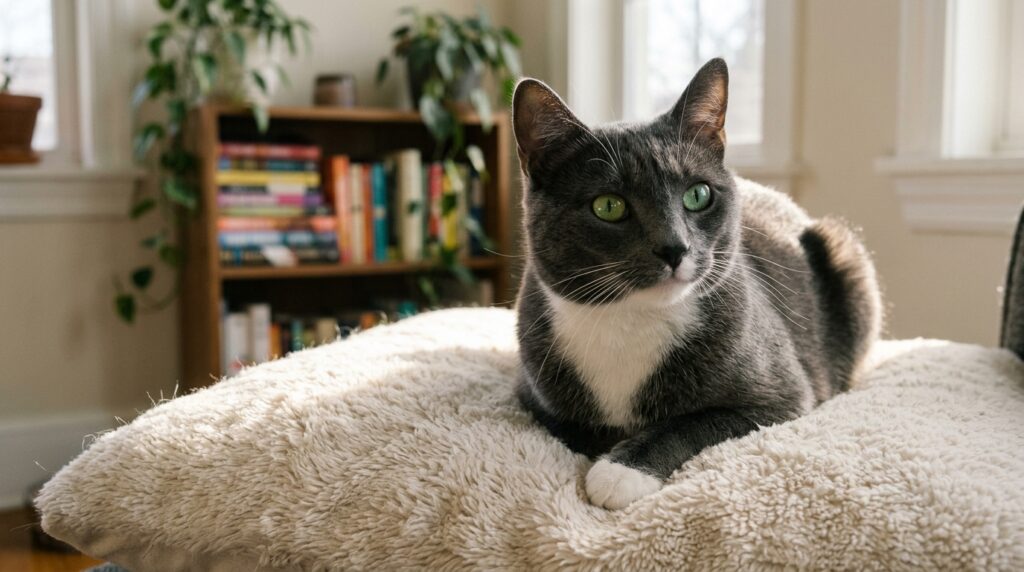
Tuxedo is a recognizable pattern, not a rare breed or a reliable clue to a cat’s sex or behavior. Both sexes can have tuxedo markings in roughly equal numbers.
Tuxedo patterns do not predict aggression or handling preferences. White spotting is not sex-linked, which is why the pattern appears in male and female cats.
| Question | Direct answer | What the pattern tells you |
|---|---|---|
| Is tuxedo rare? | No | It is a coat pattern, not a breed |
| Are tuxedo cats mostly male? | No | Both sexes occur in roughly equal numbers |
| Does tuxedo mean aggressive? | No | Markings do not set behavior |
How common the pattern is
Tuxedo markings are not rare enough to identify a particular breed. They can appear in different cats, and the visible contrast may make them easy to notice.
White spotting in tuxedo cats is linked to genes that affect pigment cell spread, not to sex. That helps explain why the pattern is not limited to male or female cats.
What markings can and cannot predict
A 2016 survey included 1,274 cats and found a slight increase in owner-reported aggression toward people during handling and veterinary visits for black-and-white cats.
That was a modest association based on owners’ reports in certain situations. It is not evidence that a particular cat is aggressive or dislikes people.
Tuxedo cats stand out because their high-contrast markings look distinctive, not because they have a special temperament. Let a cat show you its handling preferences instead of assuming it will enjoy being picked up.
What Grooming and Everyday Care Does This Coat Need?
Grooming needs depend more on coat length and texture than on whether the fur is gray, white, or both. Short fur often takes less brushing than a long, thick coat, though each cat still needs basic care.
No cat breed is completely hypoallergenic. Coat type may affect loose hair and grooming, but it cannot promise that a cat will not trigger allergies.
Match brushing to coat type
A gentle routine can help you spot tangles and loose hair before they build up. Use an approach suited to the fur rather than brushing every cat the same way.
| Coat type | Examples | Grooming approach | Practical note |
|---|---|---|---|
| Short and dense | American Shorthair, British Shorthair | Regular brushing | Short fur does not guarantee allergy relief |
| Long and flowing | Persian | Daily brushing and combing | Pay attention to tangles |
| Thick double coat | Norwegian Forest Cat | Regular combing, especially during shedding | Expect more loose undercoat |
| Short and wavy | Devon Rex, Cornish Rex | Handle the coat gently | Avoid vigorous brushing |
Persian coats need daily brushing and combing to manage their long fur. Norwegian Forest Cats have thick double coats, while Devon Rex coats are short and wavy.
Keep up with routine health and enrichment
Feed a balanced diet and keep clean water available. A clean litter box also supports comfort and gives you a clear view of changes in your cat’s habits.
Offer play that suits the cat’s interest, such as a wand toy or a ball to chase. Veterinary care helps you address health concerns and discuss the cat’s needs.
If allergies are a concern, spend time with the individual cat before bringing it home rather than relying on coat length alone.
How Do You Choose a Cat That Fits Your Home?
The right match is the cat whose daily needs fit your routine, not simply the one with the most appealing markings. Your schedule, household, and comfort with coat care all matter.
Consider the cat’s activity, care needs, and response to the people in your home. Breed can offer clues, but individual cats within a breed may behave differently.
Use this four-point checklist before choosing:
- Think about the time you have for play and companionship.
- Consider your tolerance for grooming and shedding.
- Check whether your space supports activity and climbing.
- Consider household members, other pets, and the cat’s comfort with them.
A British Shorthair is often described as calmer and quieter, while a Cornish Rex is known as inquisitive and social. Those descriptions do not guarantee how a particular cat will act.
An American Shorthair is described as even-tempered, but that trait also does not replace meeting the cat. Scottish Folds may have short or long coats, so their care needs can differ.
Think about what a normal weekday looks like in your home. A cat that needs frequent play may be a poor fit if everyone is away for long stretches.
Meet the individual cat when possible and consider how it responds to the people and activity in your home.
Where Can You Find a Gray-and-White Cat to Adopt?
Shelters and rescue groups are practical places to meet gray-and-white cats, including many without pedigree papers. Available adoption listings may include mixed-breed and pedigreed cats.
Coat appearance and breed availability vary by cat and organization. Domestic shorthair and domestic longhair are coat-length categories for non-pedigree cats, not breed names.

Use these steps to narrow down your options:
- Check animal shelters and rescue organizations.
- Describe the coat pattern and coat length you prefer.
- Ask about the cat’s observed behavior, health history, and care needs.
- Meet the cat and confirm its needs fit your household.
Some groups focus on particular breeds, while shelters may care for cats with many backgrounds. A cat’s appearance does not confirm that it has pedigree papers.
If you have a preferred look, describe the markings rather than asking only for a breed. A rescue worker may know whether a cat has a gray tabby coat, white paws, or a suit-like pattern.
You can also choose a name that suits the coat or the cat’s style. Misty, Ash, Patches, Domino, and Stormy are all options.
Before you commit, ask the adoption organization what it knows about the specific cat’s health, behavior, and ongoing care.
Some cats arrive with detailed records, while others have an unknown past. Before you commit, ask the adoption organization what it knows about the specific cat’s health, behavior, and ongoing care.
Conclusion
A gray-and-white coat can be part of the appeal, but a good match depends on the individual cat. Markings describe appearance; they do not prove breed or set temperament.
Choose a cat whose care needs and personality suit your household. A shelter or rescue can share what it has observed about a cat’s health and behavior.
Arrange a meeting with an adoptable cat and ask about its history. Meet a cat whose needs fit your life, and let its personality complete the picture.