Gray Tabby Cats: Patterns and Personality
A gray-striped cat may catch your eye, but its coat tells you more about appearance than temperament. A gray tabby can bring striking markings into your home, yet appearance alone cannot reveal how a cat will act with people. You may be choosing a pet for the first time, or trying to find a good match for a busy household. Knowing what the coat can show helps you focus on the right questions. You will learn how to spot common patterns, understand color terms, and think about personality without relying on coat-based guesses. You will also find practical tips for preparing your home and meeting cats whose needs fit your daily life. Coat color is a clue to appearance, not a promise about behavior. Meeting a cat in person is the most reliable way to judge whether its personality suits your home.
What Defines a Gray Tabby’s Coat and Markings?
A gray tabby is a cat with gray coloring and tabby markings, not a separate breed. The word tabby describes a coat pattern that can appear in many kinds of cats. You can see tabby markings in pedigreed cats and mixed-breed cats alike.
Tabby describes a pattern, not a breed
A tabby cat may have a known pedigree, or it may come from mixed ancestry. The coat pattern alone does not tell you which breeds appear in a cat’s family. Domestic shorthair and domestic longhair describe coat length, rather than pedigreed breeds.
Those labels can help describe a cat’s appearance, but they do not name a specific breed. A short-haired tabby and a long-haired tabby can each have a range of markings. Their coats may also vary in color.
The forehead mark and body markings
Many tabbies have an “M” shape on the forehead, paired with markings across the body. These may appear as stripes, spots, lines, flecks, bands, or swirls. The exact mix varies from cat to cat.
The forehead “M” is a useful clue, but it does not identify the body pattern by itself.
Look at the face and body together when describing a cat’s coat. A single feature can be hard to read, especially when markings blend into lighter hair. The Cat Fanciers’ Association recognizes four basic tabby patterns, each with its own look.
Lighting can also change how a gray coat appears in a photo. Natural light makes the contrast between the base color and darker markings easier to see. Use the overall coat pattern to describe appearance, not to guess a cat’s ancestry.
How Can You Identify the Four Tabby Patterns?
Check the sides first: narrow lines, broad swirls, spots, or an almost even coat point to different tabby patterns. The Cat Fanciers’ Association identifies four basic tabby patterns: mackerel, classic or blotched, spotted, and ticked. The body gives you the clearest first clue.
Mackerel and classic markings
Mackerel tabby cats usually have dense, narrow stripes along the body. Their legs and tail often show bars, and the forehead usually has the familiar “M.” Mackerel is the genetically dominant tabby pattern.
A classic tabby, also called blotched, has broad, dense spirals and whorls on the sides. The wide curves can look like large swirls against the base coat. From a distance, this pattern may seem less striped than mackerel markings.
Spotted and ticked coats
A spotted tabby has spots that vary in size, shape, and arrangement. Some spots may run together like broken mackerel stripes. A ticked tabby’s body usually lacks clear stripes, spots, or blotches when viewed from above.
The face, legs, and tail of a ticked tabby generally show tabby markings. Its body can look nearly solid from above, since individual hairs carry bands of color. The table highlights the quickest clues to check.
| Pattern | Body appearance | Face or limb clues | Quick identification |
|---|---|---|---|
| Mackerel | Narrow, dense stripes | Barred legs and tail | Striped sides |
| Classic or blotched | Broad side whorls | Tabby face and limbs | Large swirls |
| Spotted | Variable spots or broken stripes | Tabby markings on face and limbs | Separate or joined spots |
| Ticked | Mostly unmarked from above | Tabby face, legs, and tail | Nearly even body coat |
Some cats show markings that do not fit a tidy picture. If a spotted coat’s markings run together, describe the visible pattern rather than insisting it fits a perfect spot shape.
What Coat Colors Can You See in Tabbies?
Gray tabby color comes from diluted black pigment, while the tabby pattern determines how the markings appear. Cat fanciers often call gray blue, while everyday American English uses gray and British English uses grey. Color and pattern are separate coat traits.
Why gray is called blue
In cat-fancier terminology, blue means a soft gray coat, not a bright blue one. A recessive variant in the MLPH gene dilutes black pigment to a blue-gray shade. The variant is not carried on a sex chromosome, so gray coloring has no built-in male or female bias.
That change affects the pigment, while tabby genes shape the pattern on the body. A cat can have a gray base with narrow stripes, broad swirls, spots, or a ticked coat. The same pattern types can appear in other colors.
Gray, silver, brown, and white markings
Silver and gray may look similar in a quick glance, but their hair can differ. Silver tabbies have pale or white hair roots beneath dark markings. A gray tabby has gray pigment through the hairs instead.
A brown tabby has a warm brown or tawny base with darker markings, rather than a gray base. A white and gray tabby cat has white areas alongside its tabby markings. The table shows what to look for across these common descriptions.
| Coat description | Base and marking appearance | Useful distinction |
|---|---|---|
| Gray or blue tabby | Gray pigment through hairs, with darker gray markings | Gray color through the coat |
| Silver tabby | Pale or white hair roots with dark markings | Light roots beneath dark tips |
| Brown tabby | Warm brown or tawny ground with darker markings | Brown-toned base, not gray |
White patches can be small or cover a large part of the body. The tabby pattern remains part of the coat description when white areas appear beside it. Parting the coat to inspect the hair roots can help separate a silver undercoat from gray pigment.
Which Breeds Can Have Tabby Coats?
A tabby pattern can appear in mixed-breed cats and in several pedigreed breeds. Maine Coon, American Shorthair, British Shorthair, Norwegian Forest Cat, Scottish Fold, Abyssinian, and Persian cats can show tabby patterns or color varieties. The colors and patterns allowed depend on the breed.
Mixed-breed cats and domestic coat types
Many gray tabbies are mixed-breed domestic cats. Domestic shorthair and domestic longhair describe coat length, not pedigree. A cat with those labels may have ancestors from more than one breed, or no known breed history.
That is why coat appearance cannot confirm a cat’s lineage. A gray tabby with long fur may look like a pedigreed cat, but looks alone cannot establish ancestry. A pedigree depends on records, not a coat description.
Pedigreed cats with tabby varieties
Several pedigreed breeds have tabby varieties, though each breed has its own accepted coat colors and patterns. A Maine Coon can have a tabby coat, as can an American Shorthair or British Shorthair. The same is true of Norwegian Forest Cats, Scottish Folds, and Abyssinians.
A gray tabby Persian cat is possible when the cat has a tabby coat in a gray color variety. Persian coats can be long and full, so their markings may look different from those on a short-haired cat. The breed name still comes from verified ancestry, not fur length or color.
When a seller or rescue names a breed, ask what records support that claim. A cat can have familiar features without belonging to a specific pedigreed line. Treat a breed label as a claim about ancestry, not as something you can confirm from gray stripes alone.
Does Coat Color Predict a Cat’s Personality?
A gray coat cannot tell you whether a cat will be bold, shy, or affectionate. No fixed personality is guaranteed by gray coloring or tabby markings. The individual cat matters more than its coat.
What owners report about tabby cats
A 2024 survey found that 34% of tabby cats matched their expected personality profile. Owners rated tabby cats highest for boldness and activity. They more often described gray cats as shy or aloof.
Those ratings reflect what owners expected and observed, not results from objective behavior tests. They can show common impressions, but they cannot predict how one cat will respond to your home. A lively tabby may enjoy play, while another may prefer a quiet lap.
Why the individual cat matters most
The same caution applies to gray and white tabby cat personality. White patches do not add a reliable clue about friendliness, energy, or confidence. Breed, socialization, environment, and each cat’s experiences all shape behavior.
Even cats raised in the same home can respond differently to visitors, noise, and handling. Watch how a cat acts during a calm meeting, and ask people who know it about its daily habits. A single greeting is only one small part of its behavior.
Spend enough time to see whether the cat approaches, retreats, or settles near you. Ask how it behaves around children or other pets if those details matter at home. If temperament is your priority, spend time with the specific cat before deciding.
What Changes as a Kitten Grows?
A kitten’s coat and eyes may change noticeably as it grows, even when its tabby pattern stays recognizable. Adult eye color begins emerging around 6-7 weeks, and kittens are generally ready for adoption at 8-12 weeks. Most kittens are weaned around 8 weeks.

Coat and eye-color changes
Young kittens may have softer coats than they will as adults. Their coat color can also become clearer as they grow, while the basic tabby pattern remains a useful way to describe their markings. Eye color starts to emerge around the same early stage.
A white and gray tabby kitten has white areas beside gray tabby markings. White patches do not change the way you describe the pattern. As the kitten grows, its coat may look fuller, and its face or body markings may stand out more.
Weaning usually happens around 8 weeks, though timing can differ between kittens. Kittens are generally ready for adoption at 8-12 weeks. Their adult eye color begins emerging around 6-7 weeks, but that does not mean the final shade is clear right away.
Preparing a calm first home
A quiet room gives a new kitten a smaller space to explore at first. Set up the basics before the kitten arrives, so it can find what it needs without crossing the whole home. Prepare these five items:
- A quiet room away from loud activity.
- A litter box that is easy to reach.
- Food and water bowls set apart from the litter box.
- A scratching surface suited to the kitten’s size.
- A safe hiding place, such as a covered bed.
Keep doors and windows secure while the kitten gets used to the room. Sit nearby and let it approach at its own pace. Let a new kitten explore one quiet room before opening up the rest of the home.
What Care Does a Tabby Need at Home?
A gray coat does not require a special diet or medical routine. Coat length, age, health, and lifestyle shape the care a cat needs. Shorthaired cats generally need weekly brushing, while longhaired cats need 2-3 sessions a week.
Grooming, meals, and preventive health
Brushing removes loose fur and helps you notice mats, skin changes, or debris. Use gentle strokes, especially around the belly and legs, where some cats dislike touch. A long-haired cat may need more frequent brushing when its coat tangles easily.
Offer balanced cat food and pay attention to portions. Follow the food label and your veterinarian’s advice, then watch for changes in appetite or body shape. Fresh water should remain easy to reach.
Routine veterinary exams are generally annual, while twice-yearly exams are often recommended for senior cats. Ask your veterinarian about vaccines, parasite prevention, and dental care. Regular tooth care can help protect your cat’s mouth as it ages.
Indoor enrichment and a safe routine
Cats commonly sleep 12-16 hours a day, and many live 15-20 years depending on health and lifestyle. Indoor safety matters across that long life. Secure screens, store medicines and cleaners out of reach, and keep small objects away from curious paws.
Offer play and resting spots that suit your cat’s habits. These five choices add variety without taking up much floor space:
- A cat tree for climbing and resting.
- A scratching post for stretching and claw care.
- A window perch for watching outdoor activity.
- A puzzle feeder that makes meals more engaging.
- An interactive toy for play with you.
Rotate toys when your cat loses interest, and keep dangling strings stored safely after play. A window view can hold attention, but it does not replace time spent playing with you. Keep a predictable play routine so an indoor cat has regular chances to move and explore.
How Can You Choose the Right Cat to Bring Home?
Choose for the cat’s temperament and needs, then consider whether its age and coat suit your household. Meeting an adult cat can show you its current behavior, while a kitten’s adult personality is less settled. Ask about health history before you commit.
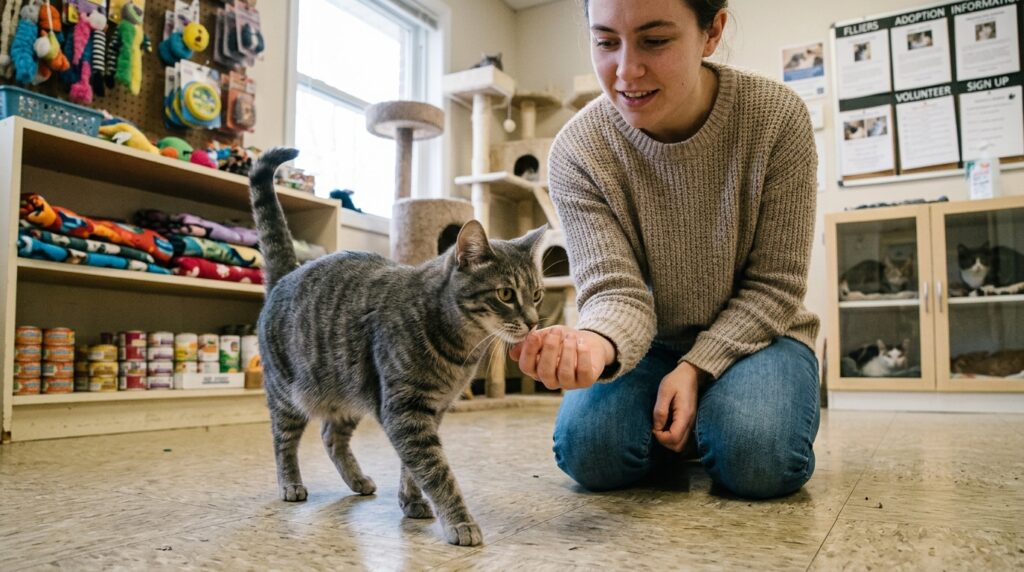
Shelters, rescues, and breeders can offer different paths to finding a cat. Use the table to guide your questions and compare the records each option can provide.
| Option | What you may find | What to check |
|---|---|---|
| Shelter or rescue | Mixed-breed adults and kittens | Health and temperament information |
| Breed-specific rescue | Pedigreed adults | Health history and breed-related needs |
| Registered breeder | Kittens of a stated breed | Registration and health records |
Specialty Purebred Cat Rescue charges $75-$175 in adoption fees for domestic cats, with the fee varying by age. The fee includes spay or neuter, feline leukemia and FIV testing, distemper vaccination, and microchipping. It also includes deworming, flea treatment, grooming, and temperament testing.
Adoption fees cover care and services, but they do not measure a cat’s intrinsic worth. A coat pattern alone does not make a cat rare or justify a premium. Compare the cat’s known needs with the time, budget, and space you can offer. Meet the cat and ask about its health history before committing.
What Names Fit a Gray-Coated Companion?
A short name inspired by a coat shade, sound, or favorite character can suit a new cat. Choose a name you enjoy saying, then notice whether it feels natural during meals and play. A name does not need to describe every marking.
These ideas group familiar words by the kind of inspiration behind them:
- Gray shades: Ash, Slate, Silver.
- Weather and nature: Storm, Misty, Pebble.
- Food: Pepper, Mochi, Sesame.
- Familiar characters: Pusheen, Jellie, Garfield.
- Blue-toned colors: Indigo, Iris, Cobalt.
Pusheen is a gray tabby, while Jellie is a gray-and-white cat added to Minecraft in 2019. Their looks can inspire a name without suggesting anything about your cat’s behavior. A name from a story or game may also feel personal if you already enjoy that character.
A name is easiest to use when it sounds clear across a room and feels comfortable in everyday speech.
Try each option during a normal routine, such as calling the cat to dinner. You can also choose a short form if a longer name feels awkward. Say your favorites aloud and choose one you can use consistently.
Conclusion
A gray tabby’s appeal is in its distinctive coat, while the cat’s individual needs matter most. The coat describes color and pattern, not breed or guaranteed temperament. Meet the cat and ask about its care and health before bringing it home.
A calm visit can help you see how the cat responds to people and a new setting. Ask what food it eats and whether it has ongoing health needs. Contact a local shelter or rescue to arrange a meeting with a cat that fits your household.
FAQ
What are the personality traits of a gray cat?
Gray coloring does not guarantee a cat’s personality. Individual temperament, socialization, and environment matter more than coat color. One gray cat may seek attention, while another may prefer quiet space. If you are choosing a pet, observe how that cat reacts to people and ask its current caregiver about its habits. A coat cannot tell you whether it will enjoy children, visitors, or other pets.
How much is a grey tabby cat worth?
Specialty Purebred Cat Rescue charges $75-$175 in adoption fees for domestic cats, with the amount varying by age. The fee includes spay or neuter, feline leukemia and FIV testing, distemper vaccination, microchipping, deworming, flea treatment, grooming, and temperament testing. An adoption fee covers care and services; it is not a measure of a cat’s intrinsic worth. Coat color alone does not set a fair price.
What colors can tabby cats come in?
Tabby cats can have gray, brown, orange, cream, and other coat colors. Color describes the coat’s base and pigment, while the tabby pattern describes markings such as stripes or spots. Those are separate traits, so the same pattern type can appear in different colors. White areas may also sit beside tabby markings, creating coats such as white and gray or white and orange.
What are tiger cats called?
“Tiger cat” commonly refers to a mackerel tabby with narrow stripes. The name points to the long, close-set lines along the sides, which can resemble a tiger’s stripes. Mackerel tabbies often have barred legs and tails, too. The term describes a coat pattern, not a breed, so cats with different ancestry can have this striped look.
Are gray tabby cats rare?
Tabby patterns are common among domestic cats, so a gray tabby is not rare just because of its markings. A particular pedigreed cat may be less readily available than a mixed-breed cat, depending on the breed and coat variety. Gray color and tabby markings do not prove pedigree. Ask for registration records if a seller claims a cat belongs to a specific breed.
Are gray tabby cats more likely to be male or female?
No, gray tabby coats have no built-in male or female bias. Gray coloring comes from a recessive dilution variant that is not carried on a sex chromosome. A cat’s sex does not determine whether its black pigment appears diluted to gray. Coat color alone therefore cannot tell you whether a gray tabby is male or female.