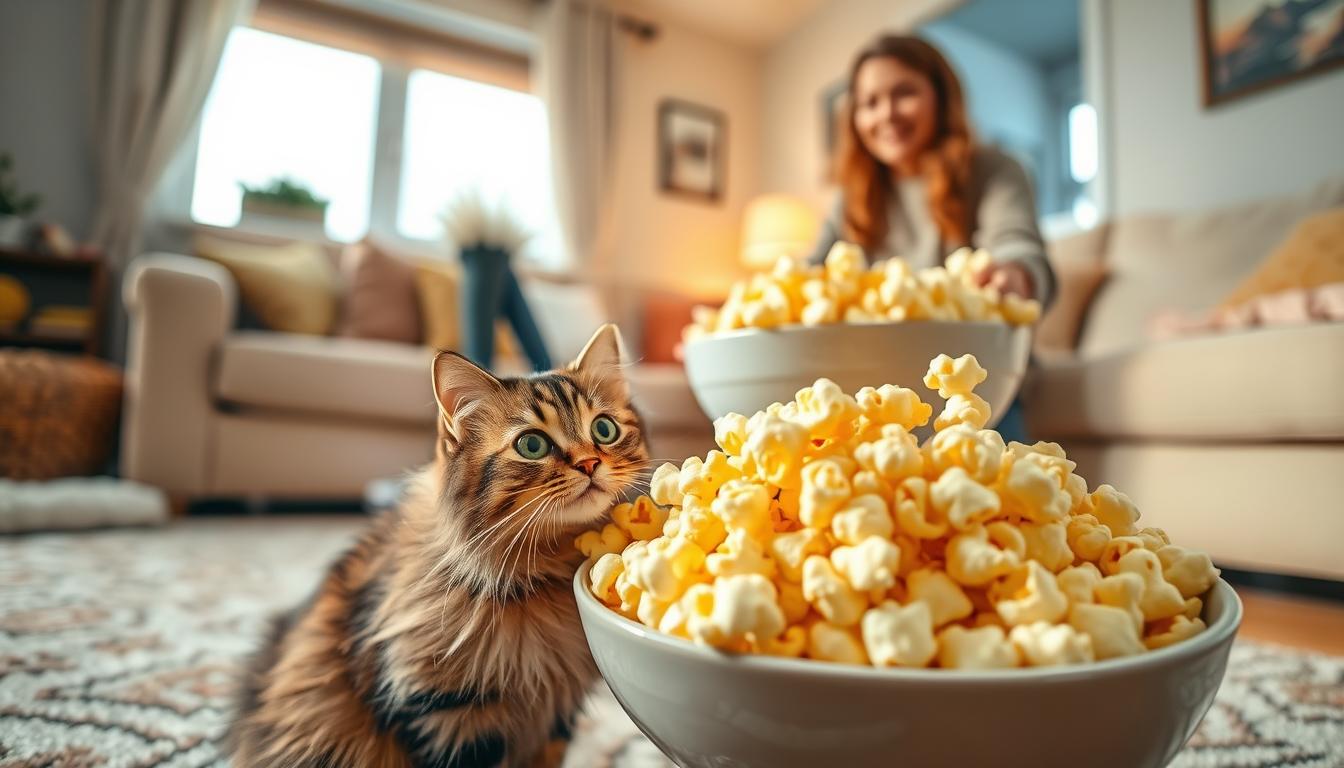
Is Popcorn Bad for Cats? Risks and What to Know
A single piece of plain, fully popped popcorn is unlikely to poison a healthy cat, but it is not a useful snack to offer on purpose. When your kitty reaches toward your bowl, it can be hard to know whether a little taste is harmless or risky. The difference matters because cats need food made for their needs, not extra bites that add little value.
A dropped piece is different from making this a regular treat. You can use the ingredient list, the kind of piece your cat ate, and your cat’s behavior to judge what to do. This article gives you clear ways to assess an accidental nibble and choose a better option for your cat’s health.
Table of Contents
Keep the popcorn bowl and hard kernels out of your cat’s reach while you enjoy your snack.
Is Popcorn Bad for Cats or Just Unhealthy?
Plain popcorn is not a recognized feline toxin, but it does not give your cat the nutrition that complete cat food provides. Not toxic and healthy are different things.
A cat is an obligate carnivore, an animal that needs nutrients from animal-based food as the foundation of its diet. Popcorn is made from corn, so it offers little of the animal-based nutrition cats need.
Popcorn is optional, and it should never take the place of complete cat food.
Cats obligate carnivores need a diet built around animal-based nutrients. Complete cat food is made to meet a cat’s daily nutrition needs, while a piece of popcorn is mostly an extra bite. If cats eat popcorn, that does not mean they gain a health benefit from it.
That distinction helps you judge an accidental nibble without treating every bite as an emergency. A small plain piece is unlikely to poison a healthy cat, but a snack can still be unsuitable, add calories, or pose a physical risk. You should also keep your cat’s age and any health needs in mind when choosing food.
Some cat owners may wonder whether popcorn counts as a treat because it is not a recognized toxin. It can be an accidental nibble, but it is not a good reason to change a cat’s usual eating routine.
Treat popcorn as an accidental nibble, not as part of your cat’s regular diet.
Is Plain Air-Popped Popcorn Okay as a Treat?
If you choose to share a nibble, the least complicated version is fully popped, plain popcorn with no added ingredients. Fully popped matters because a hard kernel creates a different concern.
There is no evidence-based serving measured by popcorn pieces or your cat’s body size. A small amount does not become a recommended treat just because the piece looks tiny.
What makes popcorn plain
Air-popped popcorn is made without added oil or butter. It also has no added salt, sugar, or other toppings. That makes it simpler than popcorn coated with extra ingredients, but it does not add a nutritional reason to feed it.
Plain popcorn means the ingredient is just popcorn, without a coating or seasoning. Check the product label if you did not make it yourself. A product may look plain while still containing added ingredients.
Even without toppings, popcorn can be dry and awkward for a cat to chew. Cats eat food in ways that suit their mouths and diets, so a human snack may not be an easy fit. If your cat shows interest, that alone is not a sign that the snack is suitable.
Why there is no standard piece count
No evidence-based rule sets one safe piece count for every cat. A cat’s tolerance and the shape or texture of a piece can affect the risk, and a hard kernel matters more than a fully popped piece.
Body size alone cannot set a reliable amount. Two cats of similar size may react differently, and kittens have different needs from adult cats. Kittens and cats on a prescribed diet are better served by sticking to food their veterinarian recommends.
If you decide to offer a taste, keep it rare and very small. Do not let it replace meals or lead you to reduce complete cat food. Your veterinarian can guide you if your cat’s diet has special limits.
Do not use a piece count as a substitute for your cat’s regular food or your veterinarian’s dietary advice.
Can Popcorn Hurt Your Cat’s Teeth or Cause Choking?
A popped piece can still be a choking hazard if your cat swallows it whole. Swallowed whole means your cat may not chew the piece into smaller bits first.
Risk depends on the piece and the individual cat. A cat’s size, chewing habits, and the shape or hardness of what it eats can all matter.
Risks from popped pieces swallowed whole
A fully popped piece may be light, but its shape can still make it hard to swallow safely. A cat that gulps it down may choke. Watch closely if your cat grabs food quickly or tends to swallow pieces without chewing.
Popcorn can also break into dry, uneven bits as a cat chews. Those bits may bother the mouth or be difficult for an individual cat to handle. A cat with trouble chewing should not be offered human snacks.
If you have wondered whether popcorn is bad for cats’ teeth, the main concern is not that every popped piece will damage teeth. A hard or partly popped piece can be tough to bite, and that may lead to tooth or mouth injury.
Risks from hard and partly popped kernels
Unpopped kernels and partly popped pieces are hard. They may hurt a tooth or the mouth, and a swallowed hard kernel can scratch the esophagus or intestines as it moves through the body.
A hard kernel may also cause gas, bloating, vomiting, or diarrhea. A piece lodged in the throat can create a choking emergency. If a cat inhales a kernel, it may lead to breathing problems.
These concerns are not the same for every cat or every piece. A soft, fully popped piece does not carry the same physical risk as a hard kernel, but neither choice is a needed snack. For more detail on popcorn safety for cats, consider the type of piece and your cat’s behavior.
Remove hard and partly popped kernels from any bowl or floor where your cat can reach them.
How Much Popcorn Is Too Much for a Cat?
There is no evidence-based number of popcorn pieces that is safe for every cat, so use the broader treat-calorie limit instead. All treats together count toward that limit, not just this snack.
Keep treats under 10% of your cat’s daily calories. That ceiling includes every treat your cat eats in a day, and it is not a target to reach.
- Count the calories from all treats your cat gets in a day.
- Keep the combined treat total below 10% of daily calories.
- Reserve the rest of the diet for complete cat food.
The 10% limit applies to all treats, not to popcorn alone. If your cat gets several treats, those calories add up even when each item seems small. A few bites of different foods can take up more of the day’s allowance than you expect.
Popcorn does not have a set piece allowance based on a cat’s weight. A small cat does not automatically have a safe number of pieces, and a larger cat does not need popcorn to meet its needs. Keep the focus on the total calories and on complete cat food.
Some treats provide nutrients or are made for cats, while popcorn offers little value to their diet. So, even if a small bite fits beneath the calorie ceiling, that does not make it a useful choice. Choose treats that suit your cat instead of trying to fill a calorie allowance with a human snack.
If you do not know your cat’s daily calorie needs, ask your veterinarian before setting a treat allowance.

Which Popcorn Toppings Are Risky for Cats?
A topping changes the risk according to its ingredients, so butter, salt, and seasoning should not be treated as one hazard. Read the label to see what your cat could have eaten.
Different ingredients raise different concerns, and not every topping is a toxin. Butter and oil add calories and may upset an individual cat’s stomach.
| Popcorn type | Ingredients | Distinct concern | Practical assessment |
|---|---|---|---|
| Plain air-popped | Popcorn only | Little nutrition | Not a needed treat |
| Oil- or butter-topped | Oil or butter | Extra calories or stomach upset | Check amount and response |
| Salted | Salt | Added sodium | Amount affects concern |
| Cheese- or caramel-flavored | Cheese or caramel coating | Extra ingredients; digestive or choking concern | Check the full label |
| Onion- or garlic-seasoned | Onion or garlic seasoning | Dose-dependent hazard | Check ingredient and amount |
Butter and oil mainly raise calorie and intolerance concerns, rather than belonging in the same category as every seasoning. Salt adds sodium, and the amount eaten can change the concern. Cheese or caramel coatings may contain several ingredients that can affect a cat’s stomach.
Cheese-flavored popcorn may also have a stronger smell and a coating that sticks to the mouth. Caramel adds a sweet coating that cats do not need. Coatings can make a piece harder to chew or swallow, adding a physical concern beyond the ingredients themselves.
Onion and garlic hazards depend on dose, so the label and amount matter. A flavor name may not tell you every ingredient in the seasoning. Look at the actual package rather than guessing from the smell or color.
Keep the ingredient package so you can identify the specific seasoning if your cat gets into flavored popcorn.
What Can Happen If Your Cat Eats a Lot of Popcorn?
A larger serving or flavored popcorn is more concerning than a small piece of plain popcorn because it can upset your cat’s stomach and introduce other hazards. The amount matters, along with the ingredients and the kind of piece.
Digestive upset is possible, but it does not happen to every cat. Choking, inhaling a kernel, or an intestinal obstruction are more serious possibilities.
| Exposure | Possible concern | Factor that changes concern |
|---|---|---|
| A few pieces of plain popped popcorn | Mild digestive upset | Cat’s tolerance and piece size |
| A large amount of plain popcorn | Gastrointestinal upset or obstruction | Total amount and kernel type |
| A large or flavored exposure | Digestive upset or ingredient hazard | Seasoning and dose eaten |
A cat that eats a lot may develop gastrointestinal upset, including vomiting or diarrhea. The risk can rise when a large amount fills the stomach or includes hard pieces. Still, an exposure does not guarantee that your cat will become ill.
Flavored popcorn adds another factor because coatings and seasonings bring extra ingredients. The concern depends on what was in the food and how much your cat ate. A small taste of one flavor is not the same exposure as eating a bowlful.
Choking can happen if a piece blocks the airway, while inhaling a kernel can affect breathing. An obstruction is another serious possibility if material gets stuck in the digestive tract. These risks depend on what happened, not just on whether the snack was plain or flavored.
Amount, ingredients, and whether a kernel was inhaled or swallowed affect what to do. Keep those details in mind when you decide whether to call for advice. Take a suspected inhaled kernel or possible obstruction seriously even if your cat seemed interested in the snack at first.

Why Is Your Cat Drawn to Popcorn?
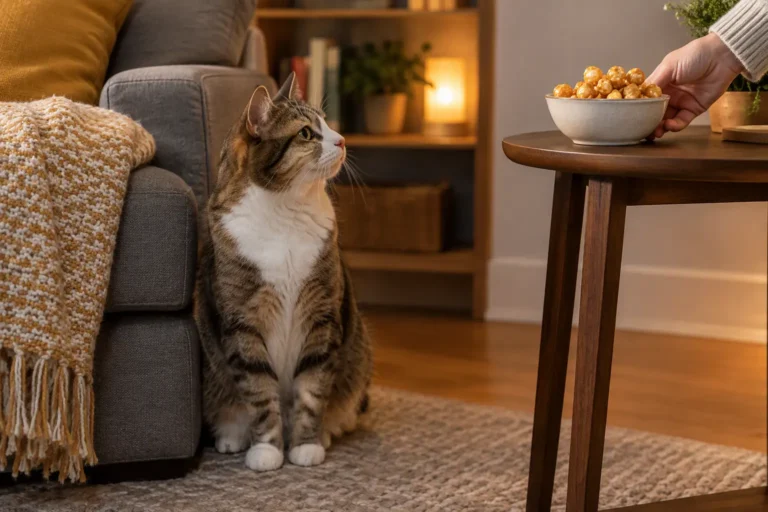
Your cat may be curious about popcorn’s smell or crunch, especially when the bowl has a strong buttery or cheesy aroma. Curiosity can explain a cat’s attention without making the food a good choice.
There is no single reason that explains every cat’s interest. Cats vary, and the smell or texture that draws one kitty may not interest another.
A cat may investigate food by sniffing it, moving close, or trying to paw at it. Eating popcorn is not proof that your cat needs corn or has found a new source of nutrients. The attention may come from a cue in the room, not from a health benefit.
Three cues may draw a cat toward the bowl:
- The smell of popcorn as it is freshly made.
- The stronger aroma of butter or cheese flavor.
- The crunchy texture of a piece under a paw or tooth.
Butter or cheese-flavored popcorn may have a stronger aroma than plain popcorn. A cat can notice that smell from across the room, then come closer to inspect. The sound of a crinkling bag or a bowl being moved may also catch its attention.
A cat loves popcorn may sound like a simple preference, but interest does not show that every cat likes it. A cat that seems obsessed with the bowl may be responding to smell, texture, or the activity around you. No one reason applies to every cat.
Some cats ignore the snack entirely, while others keep returning to investigate. Their interest does not show a nutritional need or a health benefit. A curious sniff is not a reason to offer a piece.
A cat’s attention to a snack tells you what caught its notice, not what belongs in its diet.
Curiosity is a reason to keep the bowl out of reach, not a reason to share seasoned pieces.
What Should You Do After Your Cat Eats Popcorn?
If your cat ate one plain, fully popped piece and is acting normally, stay calm and check that no hard kernel was swallowed. One plain piece is different from a larger or seasoned exposure.
Save the package and note the details before you call your veterinarian. Clear facts help the clinic judge what your cat ate.
Note the details of the exposure
Write down the key details while they are fresh:
- Save the package or take a clear picture of it.
- Identify the listed ingredients and seasonings.
- Estimate the amount your cat ate.
- Note when the eating happened.
- Record your cat’s weight and any symptoms.
If the exposure involved plain, fully popped popcorn, monitor your cat and make sure the piece was not a hard kernel. A single piece is unlikely to be toxic, but a swallowed hard kernel changes the concern. Do not assume that a cat ate only the piece you saw.
The package can help you identify seasonings that are hard to recognize by sight. An estimate is useful even if you did not see every bite. Note whether the food came from a bag, a bowl, or a seasoned product.
Avoid home treatments
Do not try to make your cat vomit or give a home remedy. Do not give salt, hydrogen peroxide, oil, milk, bread, charcoal, or human medication. These can create added risks or delay the right care.
Keep your cat in a calm place while you gather the facts. Do not force food or liquid into its mouth. A veterinarian can tell you what steps fit the food, amount, timing, and your cat’s condition.
Call your veterinarian for guidance if the exposure involved a large amount, a concerning ingredient, or any symptom.
Which Signs Mean Your Cat Needs Veterinary Advice?
Trouble breathing, choking, or sudden mouth pain after eating popcorn needs prompt veterinary attention. Trouble breathing is urgent, not a wait-and-see sign.
Choking or breathing trouble calls for urgent veterinary help. Coughing after eating may also need a call, especially if it continues.
| Sign or situation | Why it matters | Response |
|---|---|---|
| Choking, coughing, or mouth pain | Airway or mouth may be affected | Urgent help for choking; call about coughing |
| Repeated vomiting or diarrhea | Ongoing digestive upset can worsen | Call your veterinarian |
| Weakness, tremors, or hazardous ingredient | May signal a serious reaction or exposure | Seek veterinary advice promptly |
Repeated vomiting and diarrhea deserve a call, even if your cat seemed fine at first. Lethargy or decreased appetite can also signal a problem after eating. Tell the clinic when the signs began and whether they have changed.
Weakness and tremors are also reasons to seek veterinary advice. A hazardous ingredient matters even before symptoms appear, so share what the label says and how much may be missing. Do not wait for a severe reaction before asking what to do.
The American Veterinary Medical Association says pet first aid does not replace veterinary care. Its first-aid tips for pet owners advise seeking veterinary help after an emergency.
When your cat has breathing trouble or is choking, contact an emergency veterinary clinic right away. If you are unsure whether a symptom is related, call your veterinarian and describe the exposure rather than waiting for it to worsen.
What Can You Give Your Cat Instead of Popcorn?
A cat-formulated treat or a small piece of plain cooked meat is a better choice than a human snack. Made for cats treats fit their needs more closely.
Keep treats occasional and make sure they remain a small part of the diet. They should not replace complete cat food.
Better options include:
- A cat-formulated treat made for your cat’s life stage.
- A small piece of plain cooked chicken, without seasoning or bones.
- A small piece of plain cooked turkey, without seasoning or bones.
- A small piece of plain cooked salmon, without seasoning or bones.
Plain cooked meat offers animal-based nutrients that fit a cat’s diet better than corn-based snacks. Remove bones and avoid seasonings, sauces, and added salt. Give only a small piece, since even a suitable food should not take over a meal.
Complete cat treats are another easy option because you can choose products made for cats. The World Small Animal Veterinary Association’s guide to feeding treats to cats says treats should not replace a complete, balanced diet.
Use treats as extras, not as a substitute for the food that meets your cat’s daily needs.
A treat can be useful for positive moments, but it does not need to come from your plate. Choose an option that suits your cat and keep the usual complete cat food as the main diet.
If your cat has a medical condition or prescribed diet, ask your veterinarian before adding any new treat.
Conclusion
The safest choice is to enjoy your popcorn without offering it to your cat. Plain popcorn is not a routine cat treat, and a hard kernel or added ingredient can bring avoidable concerns.
A cat-specific treat is the simpler choice when you want to share a snack moment. Put a cat-formulated treat within reach before your next movie night instead.